Aussie Readers
Begin your at-home learning adventure
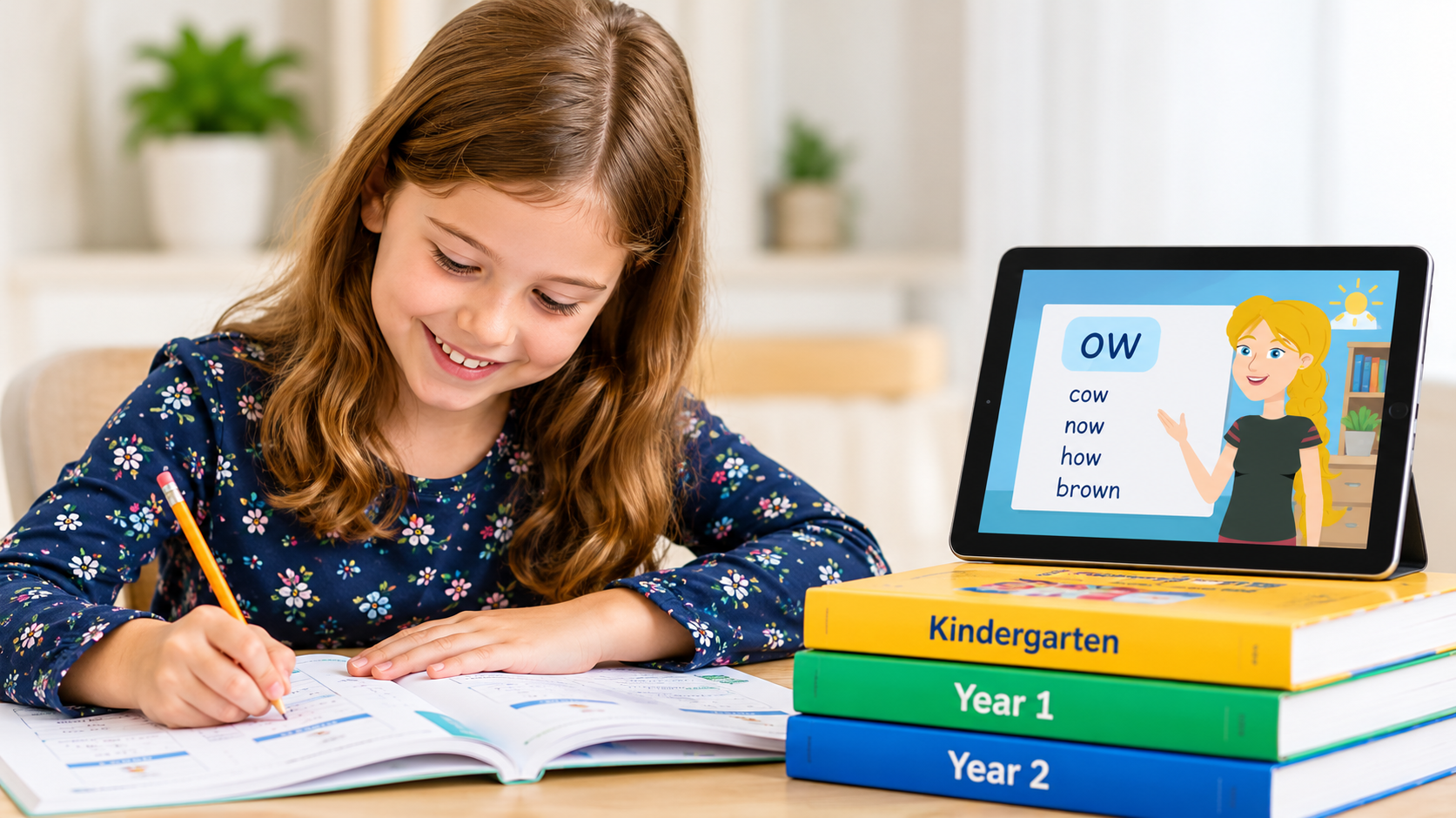
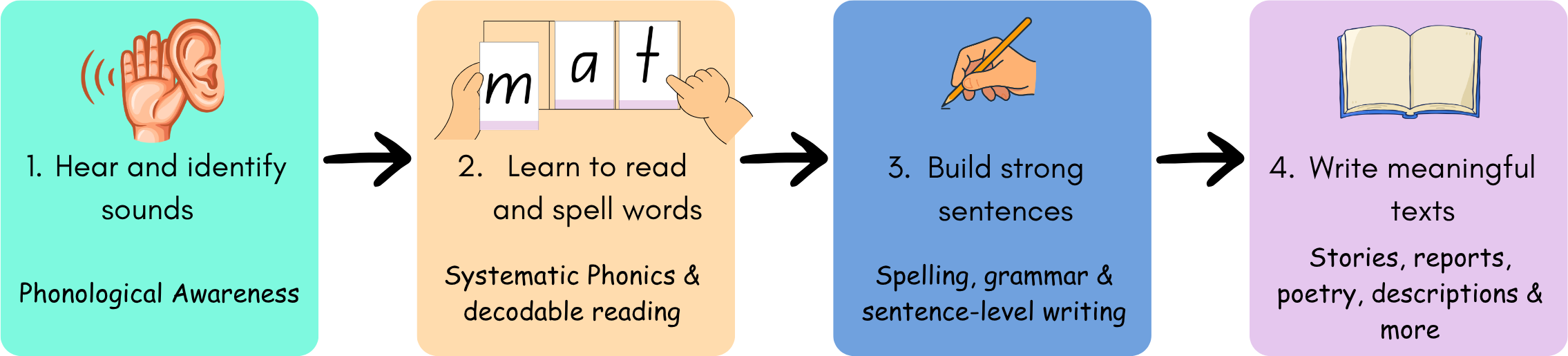
Aussie Readers is a complete English course that teaches your children to read, comprehend, spell and write.
Based on the Science of Reading Research
Proven Science of Reading
The most effective reading programs explicitly teach phonological awareness, phonics and language comprehension skills.
Course Structure
The courses are broken into 4 learning blocks, each with 10 weeks of lessons.
Curriculum Links
All lessons are linked to the Australian Curriculum Version 9. Additional documentation for home school registration in NSW and Victoria is provided.
Course Structure
The Kindergarten (also known as Foundation, Prep and Reception in states outside of NSW) Year 1 and Year 2 courses are provided in 4 parts (4 terms). Each part contains 10 weeks' worth of explicit instructions, lessons and activities. The final week of each term contains progress monitoring assessments and time for revision.
Children are provided with access to one week's worth of lessons at a time. When completed, they progress to the next set of lessons. Revision is built into the course, so sounds and skills are frequently revised.
Each week includes 4 explicit instructional lessons, a storybook and comprehension lesson, and suggested supporting activities to develop newly learned sounds and skills.
Reviews
The Proven Science of Reading
Reading is arguably one of the most important skills we learn in life. We read to communicate, to learn, and to participate in the world around us. There has been extensive debate and research into the best ways to teach reading, and there is now a strong body of evidence identifying the most effective methods. Through my own study and experience, I have found that teaching reading through systematic, synthetic phonics is far more effective than the whole language approach.
One of my favourite quotes is:
“If a child memorises ten words, the child can read only ten words. But if a child learns the sounds of ten letters, the child will be able to read 350 three-sound words, 4,320 four-sound words and 21,650 five-sound words.”
— Martin Kozloff
Through my research and training, I have found Scarborough’s Reading Rope and Gough and Tunmer’s Simple View of Reading to be exceptional models for understanding how children learn to read. Their findings can be summarised in the following statement:
Reading comprehension occurs when effective decoding skills are combined with strong language comprehension.
You can learn more about these models here:
I am a qualified K–6 teacher and have been teaching children since 2003. From 2015 to 2021, I taught Year 1, where the primary focus was helping children learn to read and write. During this time, I had the opportunity to trial and explore several systematic synthetic phonics programs and saw outstanding results in the classes I taught.
Since 2023, I have worked in both school and home education settings, tutoring homeschooled students part of the week while continuing to teach in schools.
In 2022, I decided to homeschool my youngest son and became involved in the homeschooling community. I was delighted to meet such a wonderful and supportive group of families. Seeing the value of home education inspired me to create a program that would provide high-quality, structured reading instruction for homeschool students.
Aussie Readers was born.
This course covers all key aspects of English, including oral language and communication, vocabulary development, phonological awareness, print conventions, phonics knowledge, reading fluency and comprehension, handwriting, spelling, and written expression. The storybook component of the program also helps children learn to understand and respond to quality literature.
It is my passion to see children become skilled, confident and independent readers who develop a lifelong love of learning.
I hope my reading program is a blessing to your family.
Kassi Gilmour
Scarborough, H. S. (2001). Connecting early language and literacy to later reading (dis)abilities: Evidence, theory, and practice. In S. Neuman & D. Dickinson (Eds.), Handbook for research in early literacy (pp. 97–110). New York, NY: Guilford Press.